


Several Changhua County residents and activists yesterday accused Premier Wu Den-yih (吳敦義) of breaking a promise he made last year to allow them to keep their houses amid fears of forced evictions.
During a morning press conference in front of the Construction and Planning Agency (CPA), residents from Siangsihliao (相思寮) in Erlin Township (二林) said Wu appears not to have acted on his promise.
“President Ma Ying-jeou (馬英九) praised Wu as a ‘merciful person’ in his dealings with the land expropriation controversy in Dapu (大埔) and Siangsihliao,” said Hsu Po-jen (許博任), a member of the Siangsihliao Support Group. “However, 10 months have passed [since Wu’s promise] and there are still residents who may face forced eviction.”
Yesterday’s press conference was timed to coincide with a meeting of the agency’s regional planning committee to discuss the future of three Siangsihliao households that face eviction to make way for the Erlin branch of the Central Taiwan Science Park.
Although the situation in Dapu, a borough of Jhunan Township (竹南) in Miaoli County, was not discussed at the meeting, several Dapu residents showed up to support Siangsihliao residents, since both communities face an uncertain future.
In July last year, more than 1,000 people — including farmers from communities that faced forced land seizures for development projects nationwide, students and farming activists — staged an overnight protest against the seizures on Ketagalan Boulevard in Taipei in front of the Presidential Office.
The following month, Wu met representatives of the groups and promised that the farmers in Dapu and Siangsihliao would be able to keep their houses on the site, while the government would find other plots of land to compensate for the farmland seized by the government.
However, the expropriation orders have yet to be revoked, which the farmers said meant that the evictions could proceed as planned.
“I am very sad to see Wu not keeping his promises,” said Hsu Shih-jung (徐世榮), chair of National Chengchi University’s department of land economics, a long-term participant in farming rights movements and opponent of land expropriation.
“Wu is premier and is the Chinese Nationalist Party’s [KMT] vice presidential candidate. How could he not keep his promises?” he asked.
The government “made a show” when media were after them over the issue, “but when the cameras turned away … nothing happened,” he said.
Siangsihliao residents and science park representatives failed to reach an agreement after about two hours of discussions and Deputy Minister of the Interior Chien Tai-lang (簡太郎), who presided over the meeting, said the science park should come up with a solution to settle the matter with the three Siangsihliao households before the next meeting.
No date has been set for that meeting.

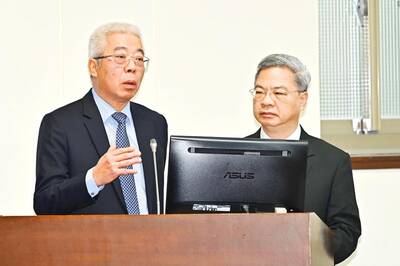
Taiwan has arranged for about 8 million barrels of crude oil, or about one-third of its monthly needs, to be shipped from the Red Sea this month to bypass the Strait of Hormuz and ease domestic supply pressures, CPC Corp, Taiwan (CPC, 台灣中油) said yesterday. The state-run oil company has worked with Middle Eastern suppliers to secure routes other than the Strait of Hormuz, through which about 20 percent of the world’s oil and liquefied natural gas typically passes, CPC chairman Fang Jeng-zen (方振仁) said at a meeting of the legislature’s Economics Committee in Taipei. Suppliers in Saudi Arabia have indicated they
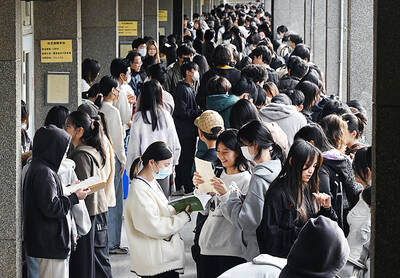
A global survey showed that 60 percent of Taiwanese had attained higher education, second only to Canada, the Ministry of the Interior said. Taiwan easily surpassed the global average of 43 percent and ranked ahead of major economies, including Japan, South Korea and the US, data from the Organisation for Economic Co-operation and Development (OECD) for 2024 showed. Taiwan has a high literacy rate, data released by the ministry showed. As of the end of last year, Taiwan had 20.617 million people aged 15 or older, accounting for 88.5 percent of the total population, with a literacy rate of 99.4 percent, the data

CCP ‘PAWN’? Beijing could use the KMT chairwoman’s visit to signal to the world that many people in Taiwan support the ‘one China’ principle, an academic said Chinese Nationalist Party (KMT) Chairwoman Cheng Li-wun (鄭麗文) yesterday arrived in China for a “peace” mission and potential meeting with Chinese President Xi Jinping (習近平), while a Taiwanese minister detailed the number of Chinese warships currently deployed around the nation. Cheng is visiting at a time of increased Chinese military pressure on Taiwan, as the opposition-dominated Legislative Yuan stalls a government plan for US$40 billion in extra defense spending. Speaking to reporters before going to the airport, Cheng said she was going on a “historic journey for peace,” but added that some people felt uneasy about her trip. “If you truly love Taiwan,

NEW LOW: The council in 2024 based predictions on a pessimistic estimate for the nation’s total fertility rate of 0.84, but last year that rate was 0.69, 17 percent lower An expected National Development Council (NDC) report expects the nation’s population to drop below 12 million by 2065, with the old-age dependency ratio to top 100 percent sooner than 2070, sources said yesterday. The council is slated to release its latest population projections in August, using an ultra-low fertility model, the sources said. The previous report projected that Taiwan’s population would fall to 14.37 million by 2070, but based on a new estimate of the total fertility rate (TFR) — the average number of children born to a woman over her lifetime — the population is expected to reach 12 million by


 RSS
RSS